Truth or Dare Wheel: Spin for a Question or a Challenge
Spin for a truth or a dare from 264 questions for friends, kids, family and couples. Pick the group and level, take off what doesn't fit, add your own and play.
The truth or dare wheel is a spinning wheel with one question on every slice, marked T for a truth or D for a dare. With Both selected, one spin picks the kind and the question together. It holds 264 built-in questions in six groups and three levels, and you can add your own.
Choose a group and a level, then press Spin, click the wheel, or press Ctrl+Enter (Cmd+Enter on a Mac). The card that opens shows the full question.
How to play a round
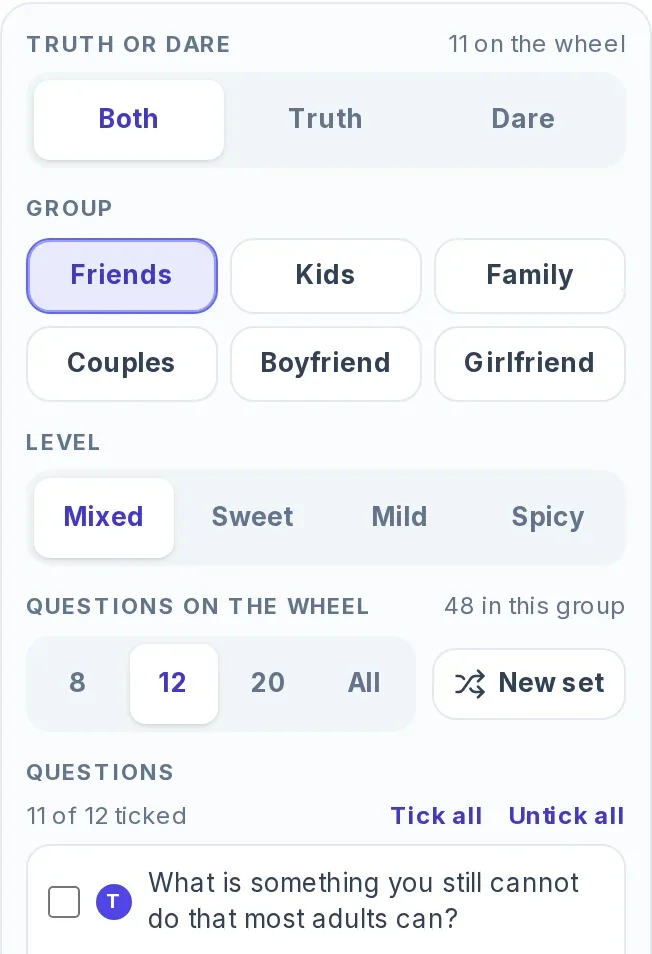
- Choose who it is for. In the Entries tab, pick Both, Truth or Dare, then a Group and a Level. The wheel rebuilds with 12 questions from that choice. On phones and tablets, the type, group and level sit under the Spin button.
- Spin. The wheel turns for about 5 seconds. Under Spin length in the Spin tab, Fast takes about 3 seconds and Slow about 7. On phones, open Settings in the bottom bar and then Spin.
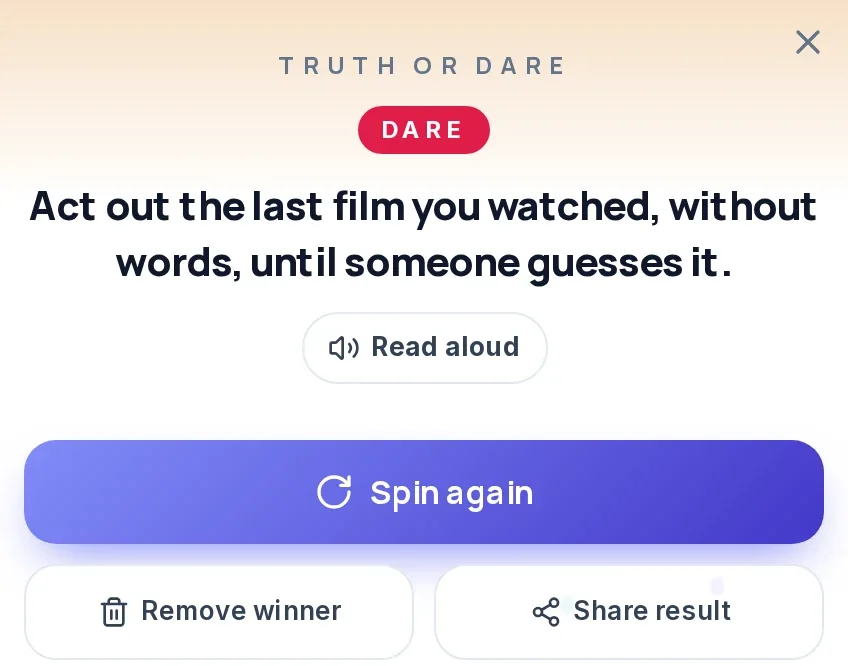
- Read the card. It shows a TRUTH or DARE label and the full question. A truth gets an honest answer, and a dare gets done. Read aloud speaks the card in your browser's voice, and the button appears only in browsers that support speech.
- Pass it on. Spin again draws the next question. Remove winner takes that question off the wheel. Share result sends the question and a link to this page through your device's share menu, or copies them to the clipboard.
The 264 truth or dare questions on the wheel
All 264 questions are ShuffleWheel's own and are in English. Each group has the same number of truths and dares, spread over three levels.
| Group | Questions | Truths and dares | Written for |
|---|---|---|---|
| Friends | 48 | 24 and 24 | A group of friends or classmates: first crushes, school embarrassments, a dramatic runway walk |
| Kids | 48 | 24 and 24 | Children: favorite animals, funny faces, walking like a crab |
| Family | 48 | 24 and 24 | Mixed ages at one table: family traditions, family trips, being the family waiter |
| Couples | 48 | 24 and 24 | Two partners: first dates, favorite memories, a slow dance |
| Boyfriend | 36 | 18 and 18 | Questions worded for someone playing with their boyfriend |
| Girlfriend | 36 | 18 and 18 | Questions worded for someone playing with their girlfriend |
Mixed uses all three levels, so Friends on Mixed has 48 questions and Boyfriend on Mixed has 36. Sweet, Mild or Spicy narrows a group to one third of it: 16 questions for Friends, 12 for Boyfriend. The count next to Questions on the wheel (for example "48 in this group") follows your group, level and type, so Friends on Sweet shows 16.
What Sweet, Mild and Spicy mean
Sweet is gentle, Mild is a little embarrassing, and Spicy is bolder. These are Friends questions at each level:
| Level | A truth | A dare |
|---|---|---|
| Sweet | Which song always puts you in a good mood? | Hum a song until someone guesses it. |
| Mild | What is the most embarrassing thing you did at school? | Do ten jumping jacks while singing the alphabet. |
| Spicy | Who was your first crush? | Sing a made-up love song to the player on your right. |
In Kids and Family, Spicy only means sillier: a Kids Spicy dare is "Waddle like a duck around the room while quacking." In Couples, Boyfriend and Girlfriend, Spicy means flirtier, and some dares are a kiss or a hug, so those groups are for two people who both want to play. There is no explicit or adult-only set.
The dares are meant to be safe to do in a living room: none involves alcohol, a risky stunt or breaking something. You still know your group better than the wheel does, so skim the list before you play.
Truth, dare or both
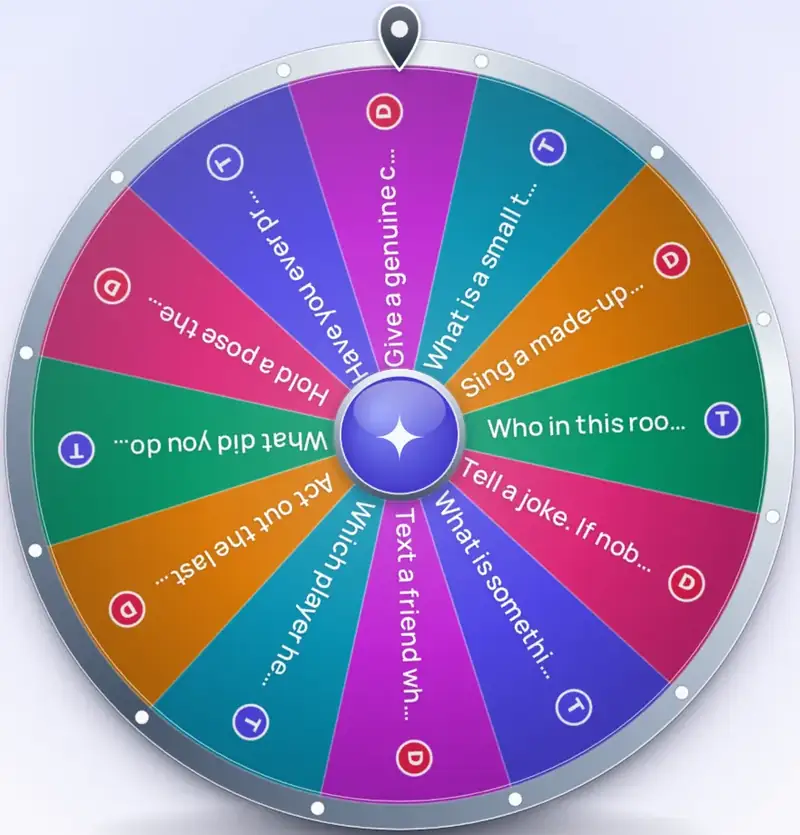
With Both, the wheel is built from equal numbers of truths and dares, and they alternate around the wheel. On the 12-question wheel that is 6 truths and 6 dares. Each single question has a 1 in 12 chance, and each spin has a 1 in 2 chance of being a truth.
Truth fills the wheel with truths only, which suits a quiet room where nobody wants to stand up. Dare gives dares only, which keeps a loud group moving. Your own questions count as slices too, so adding five truths to a Both wheel makes truths more likely than dares.
Set the wheel up before the first spin
Questions on the wheel offers 8, 12, 20 or All. All puts the whole group on the wheel: 48 questions for Friends, Kids, Family and Couples, and 36 for Boyfriend and Girlfriend. New set draws a fresh random set from the same group, level and type, and it is switched off when the wheel already holds every question. Until you press it, the questions on the wheel are the same every time the page loads, so press New set before your first game if you want a different set.
The Questions list under the buttons shows every question on the wheel with a tick box and its T or D label. Untick a question to take it off the wheel. The line above the list counts them ("11 of 12 ticked"), and Tick all and Untick all work on the whole list. Skim it once before you hand the screen to a group. Each change to the type, group, level or size rebuilds the wheel from the lists, so make those choices first and edit the questions afterwards.
Add your own truths and dares
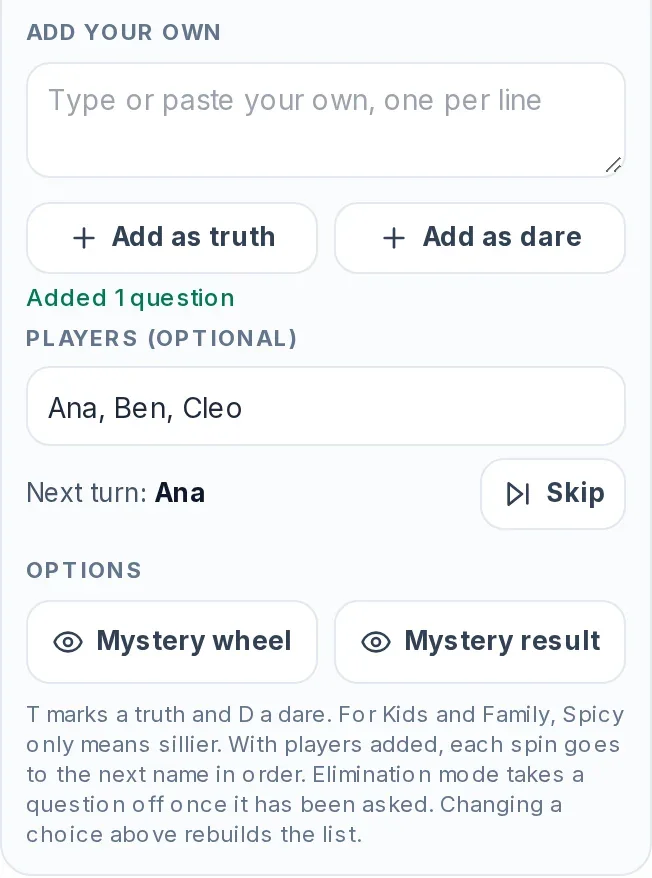
Type or paste your own questions into Add your own, one per line, then press Add as truth or Add as dare. A line that starts with "Truth:" or "Dare:" keeps that type whichever button you press, so a mixed list goes in with one click. Your questions join the list with the same T or D label and an x to remove them, and a note under the buttons says how many were added.
They stay on the wheel when you change the group, level or type, and one wheel holds up to 1,000 entries. A teacher could paste five questions about the book the class is reading. Before a birthday party, you could add ten about the guest of honor, such as "Truth: What was the first thing you bought with your own money?"
Take turns with players
Type names into Players (optional), separated by commas, and the wheel keeps that order. Each spin goes to the next name: the card shows "Ana's turn" above the question, and a Next turn line with a Skip button shows who is up next. Skip passes over that player without a spin. The box takes up to 50 names, and the Results tab records each spin with the name, for example "Ben, Truth: What is a small thing that makes your day better?" The Results tab keeps the last 50 spins, newest first, with Copy results and Clear.
The turn order follows your list and is not random, and the wheel only picks the question. To pick who goes next at random, use the Random Name Picker.
Play without repeats
The Spin tab has a Mode setting, and two choices matter for this game. In Normal, every question stays on the wheel and each spin is independent, so on a 12-question wheel the next spin repeats the last question 1 time in 12, about 8 percent. In Elimination, each question leaves the wheel when you close its card, so nothing repeats until you reset.
An 8-question wheel in Elimination gives 7 questions and then shows "All done!" with a Reset wheel? button that puts all 8 back. Remove winner is not shown in Elimination, because closing the card already removes the question. In Normal mode, Remove winner takes off the question you just played.
Hide the questions with the Mystery options
The wheel shows only the first words of each question, so a player can read ahead and hope to dodge a slice. Mystery wheel, under Options in the Entries tab, replaces every slice with a question mark, and the T and D badges go with it. Mystery result keeps the card at a question mark until you press Reveal answer. The two work separately.
What you can read on the wheel
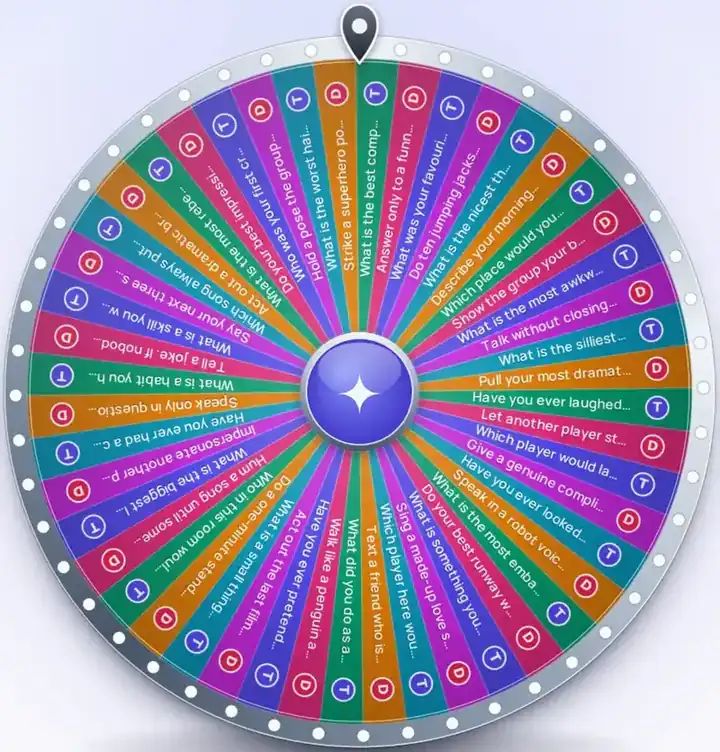
Each slice shows the opening words of its question, cut off with three dots, and the full question appears on the result card. On a screen 1,280 pixels wide, the 12-question wheel shows the opening words in a comfortable size. With All, Friends puts 48 questions on the wheel: the slices are narrow and the type is small, and the T or D badge on each slice is still easy to spot. If a group reads the wheel from a TV or projector, choose 12 questions or fewer.
Is the draw fair?
Every question on the wheel has the same chance. The browser's cryptographic random number generator picks the winner first, and the wheel then turns to land on it, so how hard you click does not change the result. Weights, a button in the Entries panel, can make some questions more likely, and it is off until you turn it on.
Chance still makes streaks. Three dares in a row is ordinary on a Both wheel, and it says nothing about the wheel.
Where it helps
- A sleepover or a party of friends. Choose Friends, Both and Mild, type the players, and switch to Elimination so nothing repeats all evening. With All on the wheel, Friends gives 47 questions before it says "All done!"
- A class or a children's party. Choose Kids on Sweet or Mild. Skim the question list before you project the wheel, and untick anything that does not suit the age. For players who cannot read the card yet, Read aloud speaks it.
- A family gathering with mixed ages. Choose Family on Sweet, untick any question your family would rather skip, and add a few of your own.
- An evening for two. Choose Couples on Sweet or Mild, or Boyfriend or Girlfriend. Agree before the first spin that either of you can pass.
- A video call. One person shares their screen and runs the wheel. The Players box keeps the order, so nobody has to remember whose turn it is.
Agree what happens when someone says no
The wheel has no Pass slice, so decide before the first spin what a pass looks like. With no names in the Players box, Spin again draws a new question for the same person, and in Normal mode the first question stays in the Results history. With names typed in, every spin moves the turn on, so a re-spin goes to the next name, and Skip passes over the player who is up next. Pick the rule that fits your group, and agree that passing costs nothing, so the game does not stall when someone gets a question they do not want.
More wheels for the same evening
The Charades Generator suits a group that wants an acting game after the questions. The Magic 8 Ball answers yes or no questions, and the Random Team Generator splits a larger group into teams if you play truth or dare as teams.
Show it on a big screen
- Fullscreen fills the screen with the wheel, which helps on a TV or projector.
- Customize and Sound change the look of the wheel and the spin and winner sounds.
- Save and share can save the wheel as a link that includes your entries and colors, download a PNG of the wheel as it looks now, or give you an embed code.
What this truth or dare wheel does not do
- It picks a question. It does not keep score, run a timer or check that a dare was done.
- There is no Pass slice and no adult-only set. Spicy means sillier in Kids and Family and flirtier in Couples, Boyfriend and Girlfriend.
- It is not an online game room. One device runs the wheel, and everyone else watches the screen or the call.
- The built-in questions are in English and have no topic tags. You narrow them by group, level and type, or by unticking.
- Player turns follow the order you typed, not a random order.
Frequently asked questions
A truth or dare wheel is a spinning wheel with a question on each slice, marked T for a truth or D for a dare. This one stops on one question and shows it in full on a card.
264 built-in questions. Friends, Kids, Family and Couples have 48 each, and Boyfriend and Girlfriend have 36 each. Every group is split into truths and dares and into Sweet, Mild and Spicy.
Yes, with the Kids or Family group. Their questions are written to suit children at every level, and Spicy there only means sillier. Skim the question list first and untick anything that does not suit your class.
No. The most daring questions are in Couples, Boyfriend and Girlfriend at Spicy, and they stay flirty. Some dares there are a kiss or a hug, so use those groups only between partners who both want to play.
Yes. Type or paste them into Add your own, one per line, then press Add as truth or Add as dare. A line that starts with "Truth:" or "Dare:" keeps that type. Your questions stay on the wheel when you change group or level.
Yes. Every question on the wheel has the same chance. The browser's cryptographic random number generator picks the winner first, and the wheel then turns to land on it, so how hard you click does not change the result. Weights are off until you turn them on, and three dares in a row is ordinary chance.
Set Mode to Elimination in the Spin tab (on phones, under Settings). Each question leaves the wheel when you close its card, and Reset wheel? brings them all back. In Normal mode, a question can come up again.
Yes. Type the names into Players, separated by commas. Each spin goes to the next name, the card says whose turn it is, and Skip passes over the player who is up next. The order follows your list and is not random.
There is no Pass slice. With no names in the Players box, Spin again draws a new question for the same person. With players added, every spin moves the turn on, so agree before the first spin whether a pass means the next name gets the new question.