Random Number Wheel 1-100: Spin to Pick a Number
Spin for one number from 1 to 100, or draw up to 10 different numbers at once.
ShuffleWheel's random number wheel puts the numbers 1 to 100 on its slices, and one spin stops on one of them. While all 100 numbers are on the wheel, each has a 1 in 100 chance. The wheel is free, runs in a browser on a phone, tablet or computer, and needs no account.
It does the job of a random number generator 1-100, but as a wheel, so everyone watching sees the pick land. Beside the wheel sits a board of all 100 numbers. The board marks each number that comes up, lets you take any number off the wheel, and sets the wheel to even, odd or multiples of 5 with one tap.
How to pick a number from 1 to 100
The page opens with all 100 numbers on the wheel and Numbers per spin set to 1, so you can spin at once.
- Spin. Press Spin, tap the wheel or press Space. Ctrl and Enter also work (Command and Enter on a Mac).
- Wait for the stop. The wheel turns for about 5 seconds and stops on one slice. In the Spin tab you can choose Fast (about 3 seconds) or Slow (about 7 seconds).
- Read the card. A card headed Your number shows the result in large type. Spin again closes the card and spins at once, and Copy number copies the number.
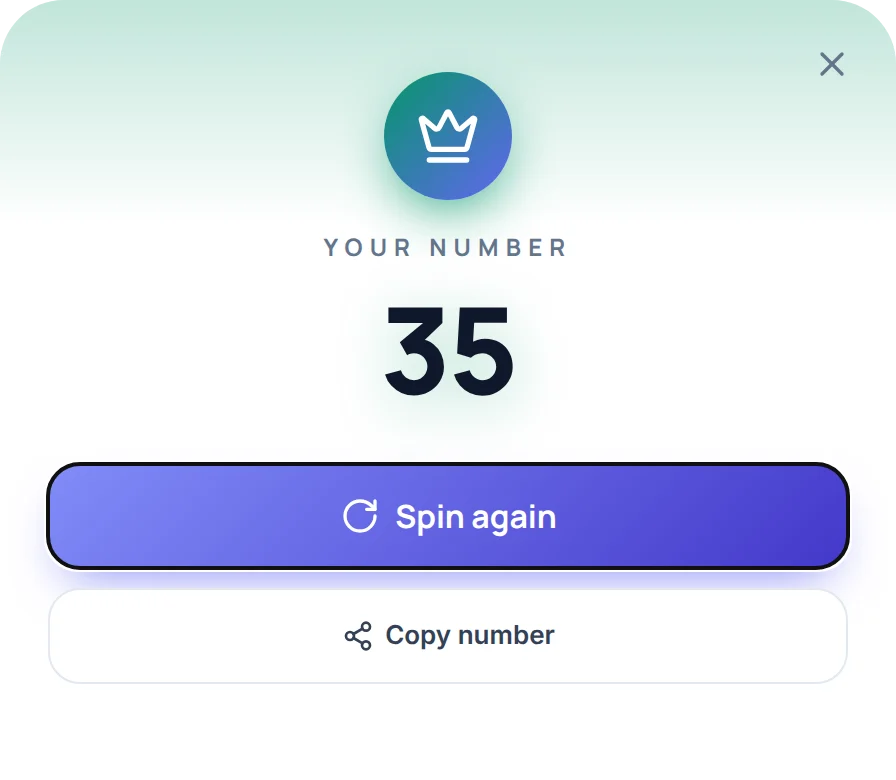
Space spins the wheel only while no button has focus. After you tap a number on the board, Space presses that number again, so use Spin or Ctrl and Enter instead. On a phone, the board and the number sets are under Numbers at the bottom of the screen.
Pick from a smaller set of numbers
Six buttons above the board choose which numbers are on the wheel.
| Button | Numbers on the wheel | How many |
|---|---|---|
| All | 1 to 100 | 100 |
| 1-50 | 1 to 50 | 50 |
| 51-100 | 51 to 100 | 50 |
| Even | 2, 4, 6 and so on up to 100 | 50 |
| Odd | 1, 3, 5 and so on up to 99 | 50 |
| x5 | 5, 10, 15 and so on up to 100 | 20 |
The wheel changes as soon as you tap, and the numbers left on it keep equal chances: 1 in 50 on Even, Odd, 1-50 and 51-100, and 1 in 20 on x5. A smaller set also gives bigger slices, so every number is easier to read.
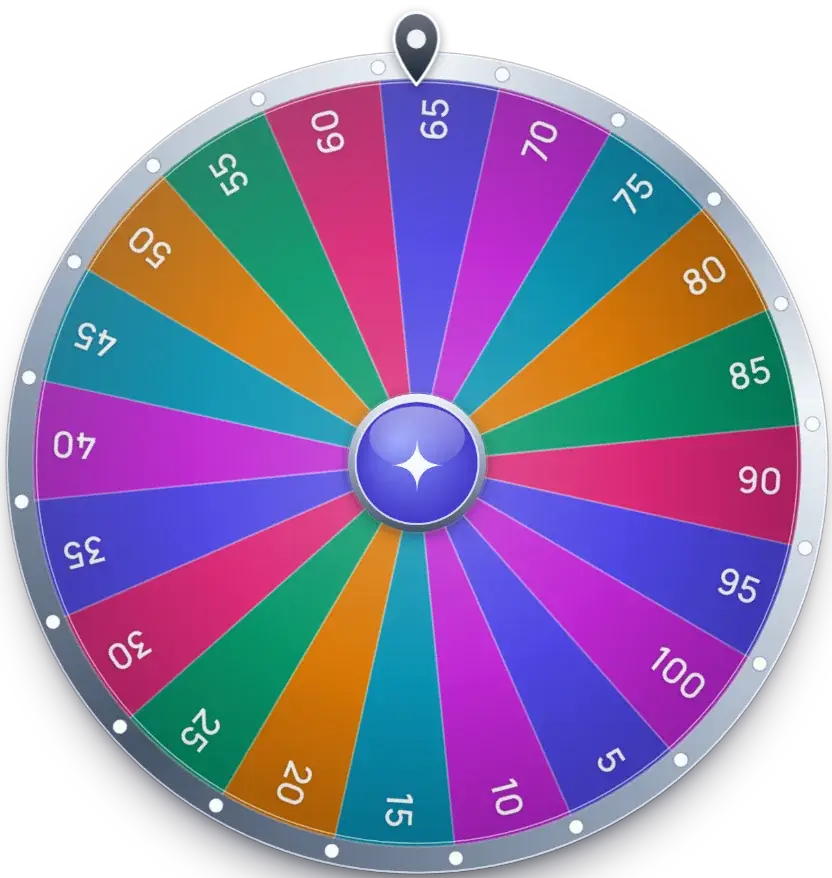
To leave out a single number, tap it on the board. It is struck through and comes off the wheel, and a second tap puts it back. Once you change a single number, none of the six buttons stays lit, because the wheel no longer matches any of them. At least 2 numbers must stay on the wheel.
Taking numbers off suits small jobs, such as skipping 13 or removing the numbers already handed out. For a whole different range, such as 1 to 30 or 1 to 500, the Any Range wheel is quicker than tapping numbers off one by one.
Draw several different numbers at once
Numbers per spin sets how many numbers one press of Spin draws: 1, 2, 3, 5 or 10. The wheel spins once for each number, and the numbers in one draw are always different. Each number takes about 2 seconds, so 10 numbers take about 20 seconds.
The numbers appear in the order drawn in the result box at the top of the panel (under the Spin button on a phone), for example 57, 18, 42, 37, 71. Copy result copies them as a list. A Stop button appears beside Spin during a draw of two or more numbers. It ends the draw after the spin in progress and keeps the numbers drawn so far.
Keep track of what has come up
The board shows the round so far. An orange number came up on the last spin. A dark indigo number came up earlier in the round. A struck-through number is off the wheel. The line under the board counts what is left, for example "99 on the wheel, 10 drawn."
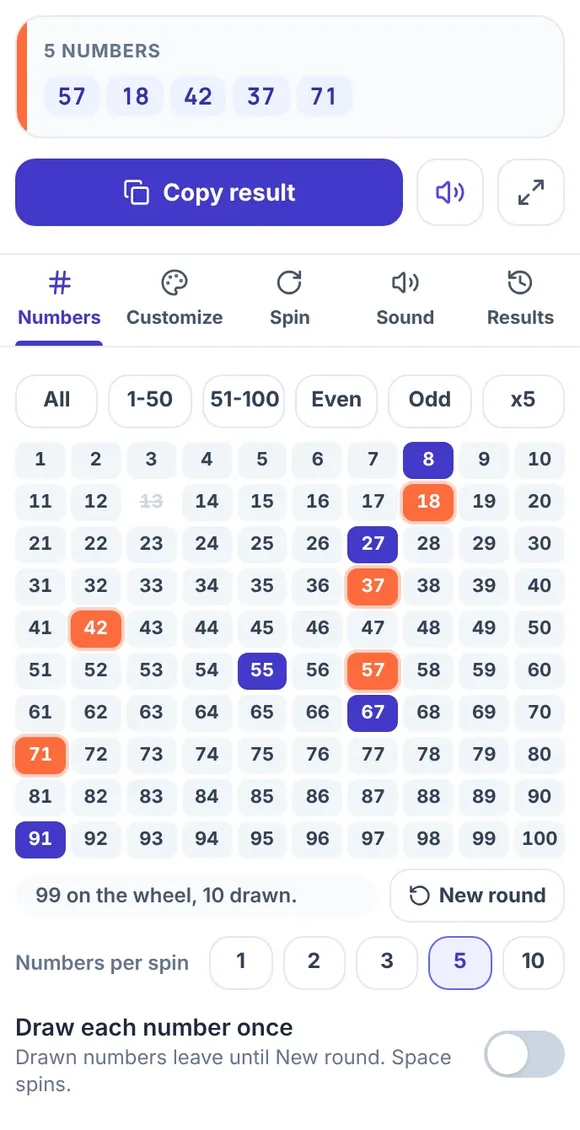
A number that has been drawn stays on the wheel unless you say otherwise, so it can come up again. The board only marks it. Three settings decide what happens:
| You want | Set | What happens |
|---|---|---|
| One number at a time, repeats allowed | Numbers per spin 1, Draw each number once off (how the page opens) | Every number on the wheel has the same chance on every spin, and a number can come up again. |
| Several different numbers in one go | Numbers per spin 2, 3, 5 or 10 | The numbers in one draw never repeat. The next draw starts again from every number on the wheel. |
| Different numbers across many spins | Draw each number once on | Each drawn number leaves the wheel. With all 100 on, the next spin is 1 in 99, then 1 in 98, and so on. |
New round clears the marks and puts every drawn number back on the wheel.
With repeats allowed, a repeat arrives early. After only 13 spins, the chance that some number has already come up twice is above 50% (about 56%). A raffle that must name 20 different winners should switch on Draw each number once.
Is the wheel fair?
Yes. Every slice is the same size, so every number on the wheel has the same chance. Your browser's built-in secure random number generator picks the winning slice before the wheel starts to move, and then the wheel turns to stop on it. The turn only shows the pick, so the moment you press Spin cannot change which number comes up.
Equal chances do not give an even spread. In 100 spins with repeats allowed, about 63 different numbers come up on average and about 37 never do. The same number can also come up twice in a row, which happens about once in every 100 spins. Both are normal for a fair wheel.
Ways to use a 1 to 100 wheel
- A raffle with up to 100 tickets. Set Numbers per spin to 3 for three different winners. If only 80 tickets were sold, tap the 20 unsold numbers first so they come off the wheel. This suits informal draws. A regulated lottery or sweepstakes has its own rules.
- Closest guess wins. Everyone writes down a guess from 1 to 100. Spin once, and the closest guess wins the prize or goes first.
- A percentage chance. With all 100 numbers on, a result of 1 to 30 comes up 30% of the time. Decide before you spin that 1 to 30 means yes. Tabletop games that call for a 1 to 100 roll can use the wheel the same way. For other dice, such as a d6 or d20, use the Dice Roller.
- A pick from a numbered list. Any list of up to 100 items works, such as a reading list, a playlist or a top-100 chart. Spin and take the item at that position.
- Practice in class. The board is laid out like a hundred chart, a 10 by 10 grid of 1 to 100, so students can find each number as it comes up. Ask for a guess, even or odd, before each spin, or switch to x5 to practice counting by fives. The Fullscreen button in the panel fills the screen. To call on a student by name, use the Random Name Picker.
What this wheel does not do
- It stays at 1 to 100. For another range, negative numbers, decimals or your own list of numbers, use the Any Range wheel.
- It cannot hide the result. The number is printed on the slice where the wheel stops, so it suits open draws, not secret ones.
- It has no weights. Every number on the wheel has the same chance.
- The slices are thin on a small screen. With all 100 numbers on a phone, the numbers on the wheel are small. Read the result on the card or in the result box, and use the board to see which numbers are on and off.
- It does not save anything. Reloading the page clears the board marks, any numbers you took off, and the last 10 results with their Times drawn counts in the Results tab.
- It is not for passwords or regulated draws. The wheel suits games, classrooms and informal raffles. Passwords, security keys and legally regulated lotteries need tools built for them.
Frequently asked questions
Yes. The wheel at the top of this page has the numbers 1 to 100 on its slices. Press Spin, and it stops on one number, with the same 1 in 100 chance for each. It is free and needs no account. For a different range, such as 1 to 10 or 1 to 500, use the Any Range wheel.
Press Spin on the wheel above, tap the wheel, or press Space, with Numbers per spin left at 1. The wheel stops on one number and a card shows it. The browser picks the number before the wheel starts to turn, so the timing of your click does not change it. Without a screen, roll a ten-sided die twice, once for the tens and once for the ones, and agree first how a roll of 00 counts, for example as 100.
No single generator is best for every job. A good free random number generator gives every number the same chance, shows the result clearly, can draw several different numbers without repeats, and works without an account. This wheel does all four for the numbers 1 to 100, and the Any Range wheel does them for other ranges. Passwords, security keys and legally regulated lotteries need tools built for them instead.
On this wheel, no number is more likely than another: each of the 100 numbers has a 1 in 100 chance on every spin. People who choose a number themselves do not pick evenly. In an informal Reddit poll, 6,750 people were asked to pick a number "at random" between 1 and 100, and the most popular picks were 69, 77 and 7, in that order, according to a 2018 blog post that shared the results. The poll was informal, so treat it as an illustration, not a measurement of everyone. A wheel has no favorite numbers.
Yes. Set Numbers per spin to 2, 3, 5 or 10, and one press of Spin draws that many numbers. The numbers in one draw are always different. They show in the order drawn, and Copy result copies them as a list. A draw of 10 numbers takes about 20 seconds.
Yes. Even and Odd put 50 numbers each on the wheel, and x5 puts the 20 multiples of 5 on it. To leave one number out, tap it on the board. It is struck through and stays off the wheel until you tap it again.